


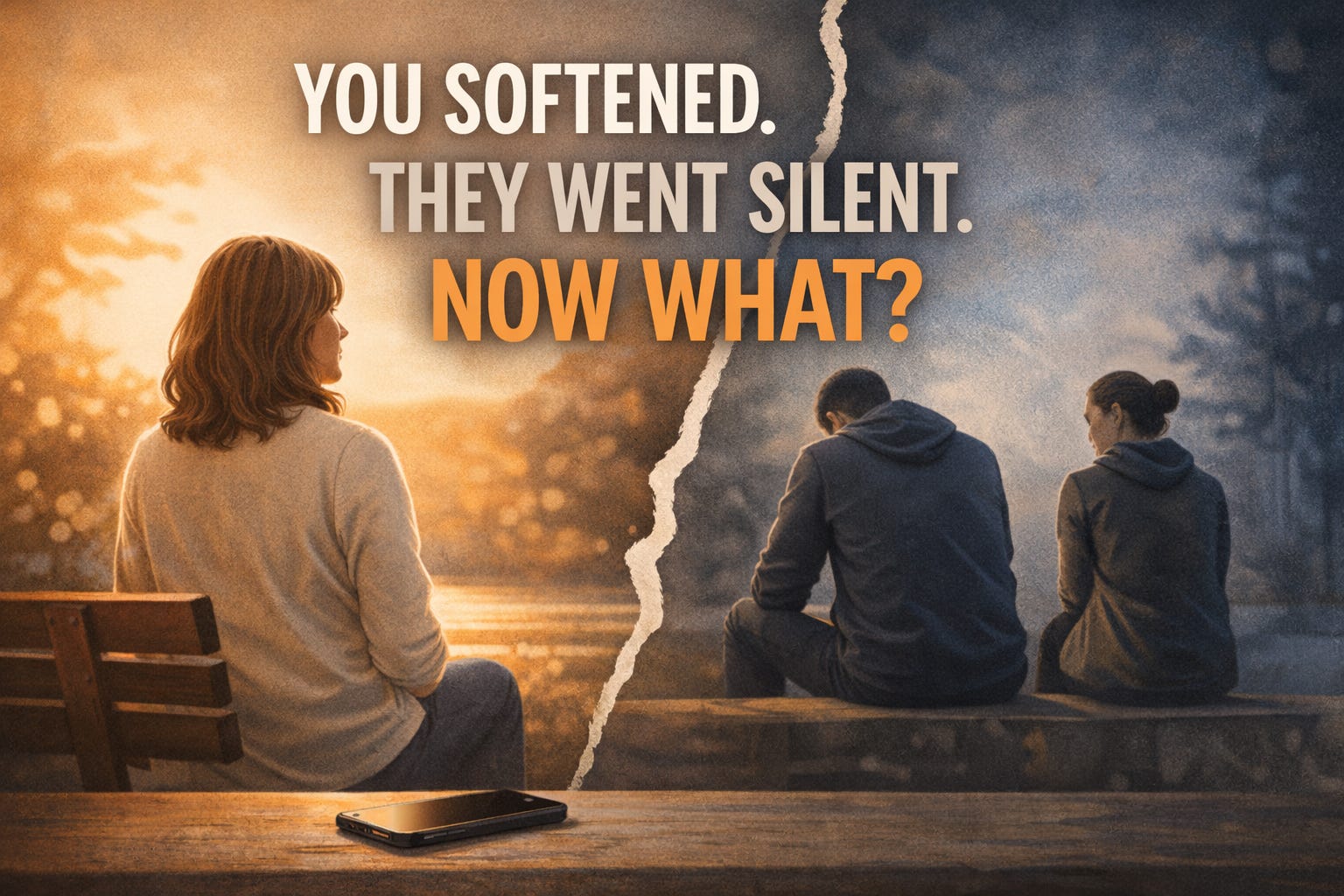
You did the thing you were terrified to do.
You let the defense drop. You stopped explaining and started exposing. Your voice trembled when you said it, your hands were shaking, and you made yourself stay present even though every instinct screamed at you to pull it back and rebuild the wall.
“When you dismiss what I’m saying, I feel like I’m disappearing. Like I don’t exist to you. And that terrifies me.”
The words came out raw and unfiltered. You let your partner see the panic, the need, the full weight of how much you ache to be held in their attention.
And then you waited for them to soften back, for their face to change, for some sign that your vulnerability landed, that they felt the weight of what you had just risked.
Instead, they go silent.
Or worse, they immediately pivot to solutions. “Have you tried journaling about this?” “Maybe we should schedule more quality time.” “I think you’re overthinking it.”
The room goes cold.
You can feel yourself disappearing again, but this time it’s worse because you just showed them everything and they looked away.
The Betrayal No One Warns You About
This is the moment that breaks people. Not the original wound, or the recurring pattern, or even the loneliness of feeling unseen, but the betrayal of finally doing the hardest thing, the thing every book and therapist told you to do, and discovering that your partner cannot meet you there.
You took the risk, dropped the armor, and let them see the terror you had been defending against for months, maybe years. And they either went blank or started trying to fix you.
Something in you hardens immediately.
See? I was right to stay protected. This is what happens when you show people who you really are. They can’t handle it. They don’t want to see it. I will never make that mistake again.
The impulse to close is not just self-protection. It feels like survival. Because if you cannot trust that your vulnerability will be met, then staying open feels like choosing to be destroyed over and over.
So you lock it down, go quiet, smile and say “never mind” or “I’m fine” and the distance between you grows wider than it has ever been.
The Stories You Tell Yourself to Make Sense of It
You will spend the next three days trying to understand what just happened.
Maybe they do not love you enough. Maybe if they really cared, they would have been able to stay present. Maybe you chose wrong, attached yourself to someone incapable of intimacy, and you are only now seeing the truth of who they are.
Or maybe the problem is you. Maybe your needs are excessive. Maybe what you are asking for is unreasonable, and their silence was actually the response to someone demanding too much. Maybe you are too intense, too hungry, too broken to be loved the way you want to be loved.
You oscillate between these two stories. One day they are the problem. The next day you are. But neither explanation feels quite right because neither account because they looked scared when you opened up. Not indifferent. Scared.
You keep replaying the moment. The way their shoulders went up. The way their jaws tightened. The way they started talking faster, as if the faster they could offer solutions, the faster the intensity would stop.
It did not look like someone who does not care.
It looked as if someone was drowning.
And here is where you get stuck. Because if they are not indifferent and you are not too much, then what the hell just happened? You have no framework for understanding how someone can want to stay present and be completely unable to. You have no language for the difference between choosing to abandon you and having a nervous system that will not allow them to hold intensity without collapsing.
So you keep cycling. Either they are wrong, or you are wrong. Either you leave, or you shrink yourself. Either you demand they do better, or you stop asking for anything at all. You try each option on, and none of them fit.
What I Know from Being on Both Sides
I have been the one who softened and was not met.
And I have been the one who could not hold it.
When my partner would finally let me see the rawness of her need, the way my distance made her feel like she was vanishing, instead of moving closer, I would feel my chest tighten, my throat close, my mind immediately start generating explanations and solutions. Letting her pain touch me felt like it would obliterate me.
If I let myself feel the full weight of her hurt, of knowing that I was causing it, of sitting inside the unbearable truth that I could not fix it instantly, I was terrified I would drown, lose myself completely, that the intensity would swallow me whole and I would never find my way back.
So I would go into my head, start analyzing, offer solutions, anything to create distance from the emotional charge in the room so my system could regulate. It was not indifference. It was terror. And from the outside, it looked exactly like I did not care.
I tell you this not to excuse what happened to you, but to show you what might happen underneath your partner’s silence.
They are not choosing to abandon you in your moment of exposure.
Their body is protecting them from something that feels like annihilation.
What Your Partner’s Nervous System Is Actually Doing
Watch what happens in your partner’s body when you expose your pain.
Their shoulders go up. Their jaw tightens. Their eyes shift away, not because they are indifferent, but because looking directly at your hurt feels unbearable. They start talking faster, offering solutions, trying to make the intensity stop, not because they do not love you, but because their nervous system is interpreting your emotional exposure as a threat they need to neutralize.
When you soften and show them your terror, their system does not register, “my partner is trusting me with something sacred.” It registers “danger, overwhelm, I am causing harm and I do not know how to fix it.”
So they do what their body knows how to do. They go silent to create distance from the intensity. Or they pivot to problem-solving because fixing feels safer than feeling. It looks like they do not care, but what you are seeing is someone without the capacity to hold what you are offering, even when they desperately want to.
The part that will make you furious: You cannot make someone have capacity they do not have in that moment. You can be as vulnerable as possible, expose your deepest fear in the most articulate, embodied way, do everything right, and they still might not be able to meet you there. Their nervous system will not allow them to stay present to emotional intensity without shutting down or scrambling to make it stop, regardless of whether they are choosing to abandon you.
The Difference Between Capacity and Willingness
The question you need to answer: Are they unable, or are they unwilling?
Inability looks like: They want to stay present, but their body will not let them. You can see them trying. They reach for you and then pull back. They start to soften and then their defenses slam shut. They apologize later. They acknowledged that they could not hold it. They are willing to work on building capacity, even if they fail repeatedly.
Unwillingness looks like: They dismiss your needs as excessive. They blame you for being too emotional. They refuse to acknowledge that their shutdown hurt you. They are not interested in learning how to stay present to intensity. They want you to regulate yourself so they do not have to feel uncomfortable.
One is a nervous system protecting itself because it does not yet know how to stay present under stress. The other is a person who has decided that your emotional reality is not their responsibility. You need to know which one you are dealing with, because the first one can change and the second one will not.
What Happens After They Fail You?
If your partner could not meet you, you will need to metabolize the disappointment without letting it confirm your worst belief about yourself. The story your nervous system will tell you is: I am too much. My needs are insatiable. No one will ever be able to hold this. I should never have opened. That story is not true. Your partner not having the capacity in that moment to stay present to your pain does not mean your pain is too big. It means their capacity is still developing.
You can hold both truths at once: You are disappointed, you risked something enormous and were not met the way you needed, and that hurt is real and valid. And also, their inability to meet you do not define your worth or the legitimacy of your need.
Grieve the fantasy that perfect vulnerability will always be perfectly received. It will not. Even in secure relationships, there will be moments when one person opens and the other cannot hold it.
The question is what happens next. Do they come back later? Do they acknowledge what happened? Do they try to repair? Do they work on building the capacity to stay present next time, even if they fail again? Or do they pretend nothing happened, blame you for being too much, refuse to engage with the fact that their shutdown left you stranded?
The answer will tell you what you are working with.
When to Accept the Limit
If your partner is willing, capacity can be built through practice. Start smaller. Do not wait until you are at maximum intensity to practice vulnerability. Find moments of lower stakes, expose something true but manageable, and see if they can stay present to it. Celebrate when they succeed, even partially. Progress is not linear, and what matters is whether they are trying.
But sometimes you will do all of this, and your partner’s capacity will not expand. They will continue to go silent when you expose your need. They will keep pivoting to solutions when you ask them to just feel it with you. They will not do the work of learning how to stay present to intensity.
At some point, you will have to decide whether you can live inside the reality of their limits. Not the fantasy of who they might become if they just tried harder. Not the potential you see in them. The actual person in front of you, with the actual capacity they have right now.
Some people decide they can. They find ways to get their need for deep emotional attunement met elsewhere, through friends or therapy or their own internal work, and they stay in the relationship for the things their partner can offer.
Some people decide they cannot. They realize that living without being met in their vulnerability feels like a form of slow disappearance, and they choose to leave. Neither choice is wrong, but pretending the limit does not exist, continuing to expose yourself and be disappointed, hoping that this time will be different, that is the choice that will erode you.
The Choice You Have to Keep Making
Every time your partner fails to meet you, your nervous system will offer you the option to shut down permanently. To decide that staying protected is smarter than risking exposure. To never soften again. And that option will feel incredibly reasonable.
But if you close, you guarantee the outcome you are trying to avoid. You ensure that intimacy becomes impossible. You turn the relationship into a place where no one is truly seen.
Staying open after being disappointed is not naive, nor is it weakness. It is the only way secure attachment gets built, because secure relating is not two people who always meet each other perfectly but two people who keep choosing to risk exposure even when they know the other person might fail, who repair after the failures, who build capacity through repeated attempts.
You soften. Sometimes they meet you. Sometimes they do not. You feel the disappointment. You name it. You decide whether this is a person who is trying and failing or refusing to try. You adjust accordingly. And then, when it feels safe enough, you try again.
Not because you are certain they will meet you this time.
But because the alternative is a life where no one ever truly knows you.
About Eric:
Eric Bensoussan is a relationship coach and nervous system specialist with 13 years of experience helping couples move beyond surface-level communication into embodied vulnerability. His work focuses on breaking recurring relationship patterns through nervous system regulation rather than traditional talk therapy approaches. He writes on Substack and sends weekly insights through The Relationship Reimagined Letter.
If you recognize this pattern in your relationship and want support learning to navigate these moments of vulnerability, book a complimentary call.