


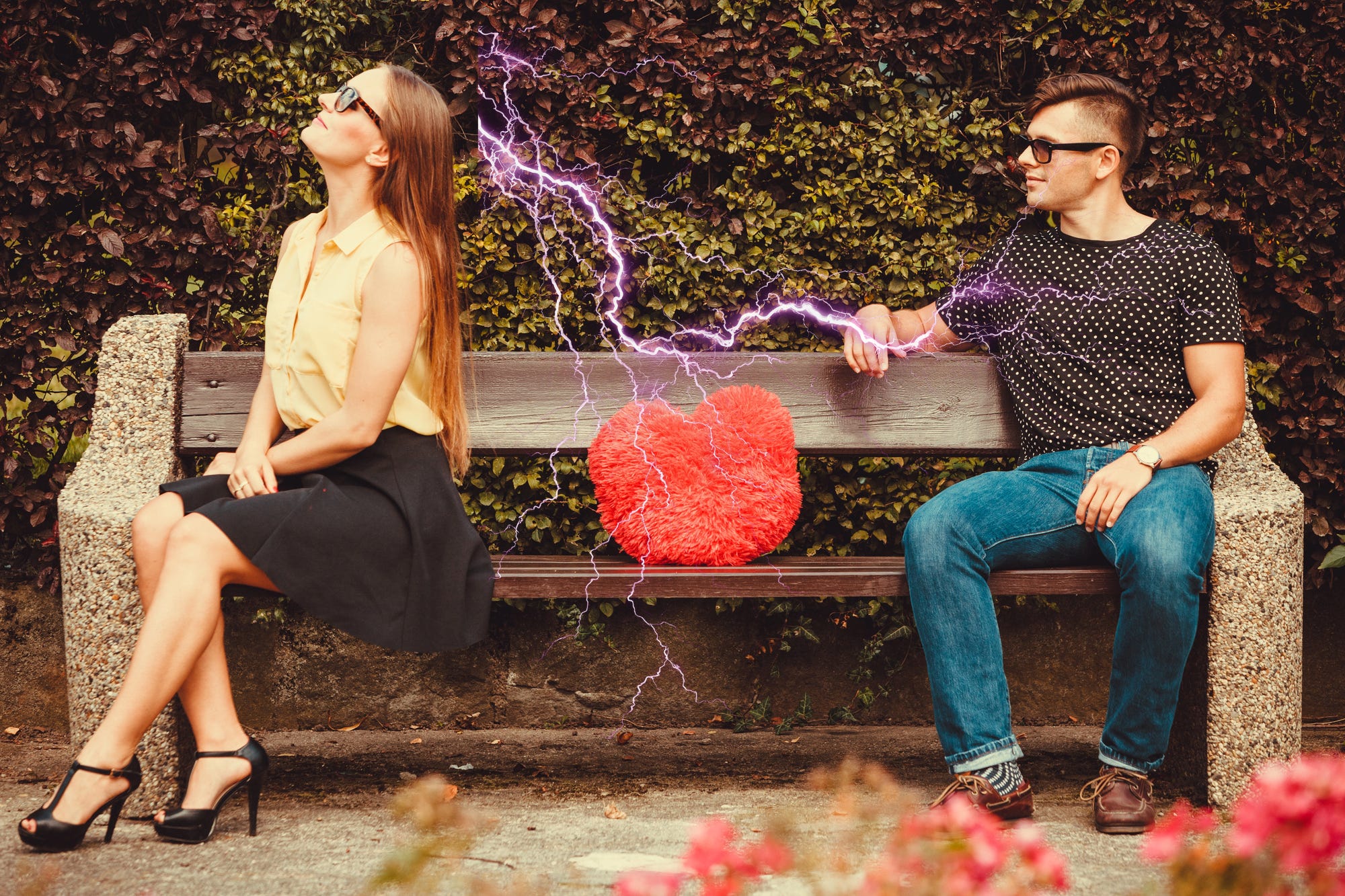
You know that feeling.
You meet someone and something in your chest moves before your brain has caught up. There is a pull, immediate and specific, that feels like recognition. Like something in you has been waiting for exactly this person without knowing it was waiting. You tell yourself this is chemistry. You tell yourself this is what it is supposed to feel like.
And then, months or years later, you are sitting with the wreckage of another relationship that followed the same arc, and you are asking yourself how you ended up here again.
Same intensity. Same dynamic. Different faces.
The First Time
The first marriage lasted fourteen years.
She was ten years older than me, which felt like strength, like certainty, like someone who had already figured out things I was still trying to locate in myself. She seemed strong and independent and self-contained. That was what I thought I was choosing.
What was actually there, underneath the surface I had fallen for, was anxiety, anger, a push and pull that never fully resolved. The tension was constant, not the dramatic kind that breaks things quickly, but the low-grade, persistent kind that keeps you slightly off balance, always adjusting, always reaching for a stability that keeps moving. I didn’t recognize it as familiar. I just lived inside it the way you live inside the weather.
Fourteen years of performing. Not performing closeness, there wasn’t much of that, but performing survival. Recreating something I already knew: the tension, the competition, the push and pull that had been the emotional language of my childhood. I didn’t recognize it as a pattern. I just recognized it as the shape of things. We separated and came back, separated and came back, the way you do when leaving feels impossible and staying feels unbearable. There were people around us during those years who made it worse rather than better, dynamics I won’t go into, but that kept us locked in something neither of us knew how to exit cleanly. Eventually, I decided I was done. Not in a moment of clarity. In a moment of exhaustion so complete that there was nothing left to argue with.
When it ended, I told myself it was the relationship. That I had chosen wrong, that we were incompatible, that the next time would be different because I would be smarter about who I chose.
The Second Time
The next significant relationship lasted four years.
Somewhere in those years I started to feel it. Not clearly, not with enough precision to name it, but a growing unease that something familiar was happening. The same pull at the beginning. The same type. The same dynamic slowly assembling itself around me while I watched and couldn’t quite find the exit.
I wasn’t in therapy at that point. I had stopped. And I had no real idea what was going on, just confusion and anger that kept building with nowhere to land. The person I was with during that period was herself a therapist, which carries its own irony: someone trained to understand human behavior, certain she had the answers, and still no framework for nervous system responses or attachment patterns. Nobody was talking about these things yet. The language didn’t exist in the rooms I had access to.
So I moved through those years without a map, feeling the pull, following it, watching the familiar wreckage assemble itself again, and having no way to reach the part of me that was running the whole operation.
The Third Time
The second marriage lasted one year.
I knew before I said yes. Some part of me recognized the frequency the moment I felt the pull, recognized the type, recognized the particular intensity that my nervous system had always called love. And I went in anyway, because knowing the pattern and being able to stop it turned out to be completely different things.
One year. The collapse came faster this time, as if my nervous system could no longer sustain the performance long enough to make even the surface of it work. Fourteen years, then four or five, then one. The pattern was speeding up. I was seeing it more clearly with each repetition, and still could not find the brake.
This time I couldn’t blame the relationship. I couldn’t call it bad luck. I had walked in with my eyes open and repeated the same thing anyway, and the only honest conclusion available to me was the one I had been avoiding: the problem was not who I was choosing. The problem was something running underneath the choosing that I did not know how to reach.
The Question That Has No Good Answer
If you have ever watched yourself repeat a pattern you can see clearly, you know the specific despair of that experience.
It is not the despair of someone who doesn’t know what they’re doing. It is worse than that. It is the despair of someone who knows exactly what they are doing and cannot stop. Who recognizes the pull the moment they feel it and follows it anyway. Who has read the books, done the therapy, acquired the language, and still ends up in the same place with a different person and the same story.
You start to wonder if this is just who you are. If the pattern is not a pattern but a character trait, something fixed and permanent that no amount of insight or intention can touch. You start to wonder if understanding is actually useless, if all the work you have done amounts to nothing more than a very articulate relationship with your own dysfunction.
And the cruelest part is that you can see it happening in real time and still cannot find the exit. You feel the pull and you know what it is, and your body follows it anyway, as if your knowing is happening in a room the rest of you have no access to. You are watching yourself from a slight distance, narrating the pattern with perfect accuracy, while somewhere below that narration the old program runs without interruption.
That gap between what you understand and what you can actually change is where many people spend years. Some spend decades. I spent three relationships finding out that seeing the loop clearly was not the same thing as being free of it.
What the Nervous System Is Actually Doing
The pull you feel toward certain people is not chemistry in the romantic sense. It is not fate. It is your nervous system recognizing a familiar frequency and responding to that recognition with something that feels indistinguishable from attraction.
The body stores every significant emotional experience it has ever had. The feeling of reaching for someone who was sometimes there and sometimes not. The particular tension of loving someone whose approval was hard to get. The specific ache of being close to someone and still feeling alone. All of it gets filed away, and when the nervous system encounters someone who produces a similar emotional signature, it responds with recognition.
That recognition feels like a connection. It feels like this person is different from everyone else, like something real is happening. And something real is happening, just not what you think. What you are feeling is familiarity dressed as destiny.
The inaccessible person feels magnetic because you already know how to love someone you cannot quite reach. The nervous system does not distinguish between familiar pain and love. It just knows this territory. It knows how to move here. It feels, against all logic, like home.
This is why understanding the pattern changes nothing by itself. By the time you feel the pull, you are already inside it. The thinking part of you can name it perfectly while the rest of you follow it home anyway.
The Template I Didn’t Know I Was Using
My mother had lost her brother before I was born. He was, in her telling, the best man in the world. And I came into that story as a replacement, the way grief does this when it has nowhere else to go. She needed me to carry something that wasn’t mine to carry. She looked at me and saw, at least in part, the shape of someone else.
I spent my childhood trying to be seen by someone who was always looking slightly past me. Not because she didn’t love me. Because her grief was louder than her presence, and no matter how close I got, there was always this quiet inaccessibility at the center of her, something I couldn’t reach and couldn’t name. I pushed away and was pulled back, resistant and desperate at the same time, for years.
The nervous system filed all of that away under love. Strong, independent, almost inaccessible. The person whose full presence you can never quite secure. The love that keeps you reaching. That was the frequency I had learned to recognize as real, as meaningful, as worth pursuing.
I didn’t make that connection for a long time. The nervous system doesn’t announce its logic. It just keeps running the same search, looking for the emotional signature it learned to call love, and delivering candidates that match.
What the Grief Finally Did
My mother died. And in the two years after her death, something in me was already shifting without my knowing it. I got closer to my father, took care of him as his Alzheimer’s progressed, watched him soften in ways he never had when I was growing up. I was losing my parents and getting to know them at the same time, and the grief of that was doing something to me that no amount of therapy had managed to do.
It was dismantling the performing self. Slowly, without my permission, with no insight or intention on my part. Just loss, doing what loss does when you stop trying to manage it and let it move through you.
When I met my current partner, the pull was there. My nervous system did what it always did: moved toward her quickly, all in before I had taken a breath. But something was different. I was still myself. Not a performance of myself, not the version organized around what she might need, but actually myself. The grief had taken the performing self down to the studs. There was simply nothing left to construct the usual architecture of people-pleasing and self-erasure.
So what showed up in that relationship from the beginning was just me. Unpolished and uncertain and present in a way I had never quite managed before. The people pleasing was still there, I won’t pretend it disappeared overnight, but something was different. For the first time I could see it happening in real time, name it to my partner, bring it into the open instead of letting it run silently underneath everything. That honesty created just enough space between me and the pattern that it couldn’t swallow me whole the way it always had before.
The Breakup I Couldn’t Take Back
A few months in, my father died.
My body shut down completely. My heart and my mind were full and inaccessible. I had no capacity to feel anything, no capacity to hear anything from anyone. I broke up with her. Plainly, the way you speak when there is nothing left to protect. I told her I couldn’t take it anymore, that it had nothing to do with her, that I was a wreck, completely hijacked by my nervous system, and I had nothing left to give anyone.
I had done versions of this before. Created distance when the emotional weight became too much. But this time it wasn’t a strategy. It was just the truth, raw and unmanaged: I was falling apart and I didn’t know any other way to say so.
Everything I had ever feared about relationships was happening in real time. I was doing the thing I had always been afraid of being.
Six Words
Three months later, when I felt myself again, I called her.
I had ended it. I had told her I was a wreck and walked away. I had no right to expect anything on the other end of that call. And I called anyway, not with a plan or a carefully prepared explanation, just with the only true thing I had: I didn’t want to lose her.
Six words. The most honest thing I had said to anyone in a relationship in my entire life, because it wasn’t organized around making her feel a certain way or securing a particular outcome. It was just true, undefended and unperformed, and I said it and waited.
She was still there.
Not because I had earned it. Not because I had managed the situation correctly. I had broken up with her in the middle of my own collapse and called back three months later with nothing but honesty. And she came back.
My nervous system, which had spent decades trying to earn the right to stay, received something it had never received before. The evidence that I didn’t have to earn it. That I could fall apart completely, be honest about it, end things badly, and still be met when I came back with the truth.
That was the nervous system finally getting the data it had been waiting for its entire life.
What Finally Moved It
After three relationships and years of therapy that gave me language without giving me anything I could use at the moment, the pull arrived. I can tell you with certainty that understanding alone does not change this.
What moved it was not a better framework. It was not a more accurate narrative about my childhood or a more precise diagnosis of my attachment style. It was a relationship where I showed up without the performance, where I fell apart completely and came back with six honest words, and where something on the other end of that stayed. My nervous system received new evidence. Slowly, reluctantly, with considerable suspicion, it started to update.
One softened moment, then another. One risk that didn’t destroy me, then another. The pull toward the familiar didn’t disappear overnight. It still arrives sometimes, that specific recognition, that frequency the body learned to call love. What changed is that I can now feel it without being completely at its mercy. There is a pause that didn’t exist before. A moment in which I can ask what I am actually moving toward. And inside that pause, something became possible between us that neither of us had experienced before. We found a way to be vulnerable with each other, not cleanly, not gracefully, but honestly. Messy and raw and true in the way that only happens when two people stop managing their presentation and just show up as they actually are. That vulnerability created a safety neither of us had known how to build before. And inside that safety we discovered something neither of us had expected: that being truly seen, not the performed version but the real one, was what connection had always been waiting to be.
That pause is everything. It took three relationships and two profound losses to find it. I don’t think it had to take that long. But I also know it couldn’t have happened any faster than it did, because the nervous system doesn’t take shortcuts. It changes when it has enough evidence that something different is safe. Not before.
Some of us need the losses first. The grief that takes the performing self apart, the separations that finally make the pattern undeniable, the moments of total emptiness that leave no room for the usual strategies. That is not failure. That is sometimes the only path available to a nervous system that learned too early to call the familiar thing love.
The relationship you’ve been looking for has always been the one where you don’t have to disappear to be loved. Where the pull doesn’t require you to perform. Where you can fall apart completely, say so honestly, and find someone still on the other end when you come back.
You don’t find a different relationship by choosing more carefully. You find it by showing up as someone your nervous system has never let you be before.
If this piece stayed with you, I am running a free live session on Tuesday, March 31st, called “What Your Body Needs Before Love Can Feel Safe”.
It is about exactly this: why understanding your patterns was never enough, and what actually creates change at the level where it needs to happen. Live on Zoom, not recorded. If something in this article moved something in you, that is reason enough to be in the room. You can save your spot below ⬇️
If this one stayed with you, share it with someone who keeps wondering why they end up in the same relationship every time.
About Eric
Eric Bensoussan is a relationship coach and nervous system specialist with 13 years of experience helping couples move beyond surface-level communication into embodied vulnerability. His work focuses on breaking recurring relationship patterns through nervous system regulation rather than traditional talk therapy approaches. He writes on Substack and sends weekly insights through The Relationship Reimagined Letter.
This is an excellent and honest story Eric. What's crazy is how relatable this is. I look back at years of dating and I was always the known by my family as the "2yr curse" and that is b/c every 2 years I would have a new boyfriend. I would always end my relationships and then look for the next one. It tended to be a "type" of guy but in the end I look back and about 90% of them were toxic, broken but fun. The fun part is always what sold me! I guess a part of me always felt like I could "fix them" and be that support who can get them out of their own way. BUT every 2 yrs I would hit my capacity and saw that things were not changing and I wouldn't be able to stick through it, so I ended them. Now, 11yrs married, I look back at the moment I met my husband and all of the things you listed were there immediately. Did I fall back into that "pattern" yes and perhaps no at the same time. Something we should talk about when you come on my live. Thanks for sharing such an incredible and eye opening story.
There’s a certain kind of writing that doesn’t just land — it recognizes you. This piece did that. It read like someone naming the things I’ve lived without ever having the language for. The way the body keeps choosing what it learned too early. The way “familiar” masquerades as “love.” The way you can see the pattern clearly and still walk straight into it because your nervous system is already halfway there.
What Hit Me Hardest
That idea of familiarity dressed as destiny — that’s been the story of my life.
The way the nervous system keeps dragging you toward the same emotional frequency, even when your mind is screaming no.
The gap between understanding the pattern and actually being able to stop it.
That gap is where I’ve lived for years.
Why It Resonated So Deeply
I’ve been writing through my own wreckage this past year — not because I’m brave, but because it was the only way I could breathe. I even wrote a book that reads like a diary, and I didn’t realize until it was finished and published that I had written my own life without meaning to. My nervous system told the truth before I did.
Your words touched the part of me that’s been trying to surface — the part that’s tired of performing, tired of repeating, tired of calling the familiar thing love.