


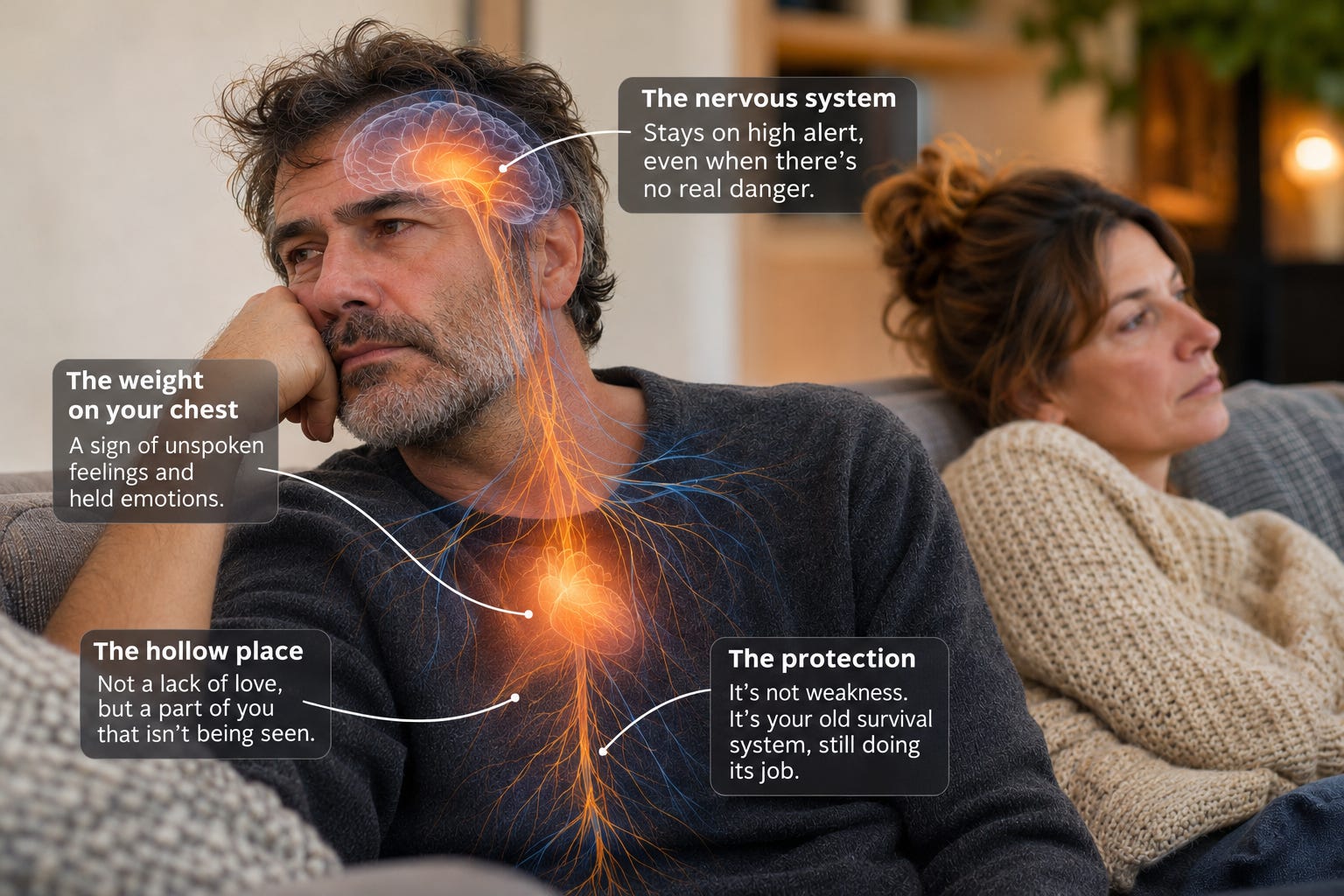
The evening looks fine from the outside. You’re both home, maybe on the same couch, close enough to touch, and the conversation moves easily between what needs doing tomorrow and what happened during the day. Nobody is upset, and yet there is a hollow place somewhere in the middle of you, and a weight on your chest that keeps you from breathing all the way down. The person you love is right there, and you feel more alone than you ever did when you were single.
If you have spent years working on yourself, this kind of loneliness is especially confusing. You know how to name what you feel, and you have probably told yourself more than once that you have no reason to feel this way. And still the feeling is there, quietly, most evenings, waiting for the moment the house goes still.
Staying busy and looking elsewhere
For a long time my answer was to keep moving. I filled my days with work, with plans and with one more thing to finish before I could sit down, because whenever I stopped, the hollow feeling was waiting for me. Being busy never made it go away, but it kept me from having to feel it.
When busyness wasn’t enough, I looked for connection elsewhere. A long conversation with a friend, a message from a colleague, an hour lost on my phone, the small lift of being noticed on social media, the warmth of people who appreciated what I did. Nothing about it was hidden or disloyal. It was simply easier to feel connected with people who didn’t know me well than with the one person who knew me best.
Going back and forth
The hardest part was not knowing where the loneliness came from. On some days I was sure it was the relationship, that we had drifted and this was simply what long relationships become. On other days I decided it was something my partner wasn’t giving me, and I would start watching for proof. And on the worst days I turned it on myself and wondered whether I was made for closeness at all, whether some part of me would always stay a little out of reach.
I moved between those explanations for years, and each one felt true while I was inside it. None of them helped, because each one either put the answer in her hands or made it a flaw in me that could never change. I kept looking for the cause in the space between us, and the space kept growing.
What the loneliness was made of
It took me a long time to see that I wasn’t lonely because no one was there. I was lonely because I wasn’t fully there either. I showed my partner the parts of me that were easy to show: what I had done that day, what I thought about things, what I was planning. What I felt underneath, and above all what I was afraid of, I kept to myself, and then I felt alone with it.
I wasn’t hiding it on purpose. Whenever I came close to saying something true, my chest tightened and something in me shut down, as if saying it out loud would make everything fall apart. I grew up in a family where feelings and what really mattered weren’t talked about, and my body learned there that keeping them inside was the safest way to belong. Years later it was still doing that job faithfully, protecting me from a danger that no longer existed in my life.
Seen that way, the hollow place and the weight on my chest weren’t signs that something was missing between us. They were what it feels like to hold yourself in. The busy days and the hours on my phone were part of the same protection, a way of feeling connected without ever risking being fully seen.
What I had been calling distance between us was mostly the distance between what I lived inside and what I let her see. Nobody can keep you company in a place you never show them.
What changed
What changed was that I began to reveal myself. It didn’t mean unloading everything at once, and it didn’t mean telling her what she had done wrong, which is easy to mistake for honesty. It meant telling her what I was really living and the fear that sat underneath it, and taking responsibility for that experience as mine. Her words or her mood might set something off in me, but what got set off belonged to my history. She was the trigger, and my experience was mine to bring.
The first conversations like that were frightening, because every part of me was braced for rejection. What I felt instead was the relief of no longer carrying something alone. As we learned to talk things through that way, there was more understanding between us and more compassion, and we became more present with each other, actually seeing the person in front of us instead of the story we had about them. The closeness I had been looking for everywhere else had been waiting at home, on the other side of what I hadn’t said.
What I see in my work with couples is that the person beside you usually feels the distance too, from the other side, without knowing what it’s made of. When one of you starts to reveal what’s underneath, it gives the other a way in.
A place to begin
If you recognize this loneliness, here is what I do now when I feel that distance coming back.
I start with my body before I start with words. When I feel the pull to escape into my phone or the next task, I take it as a sign that my body is protecting me, and I stay. I notice where the loneliness lives, the emptiness in my middle or the weight on my chest, and the tightening that comes when I think of saying it out loud. I slow my breathing and let my feet feel the floor until the shutdown softens enough that speaking feels possible.
Then I ask myself what I am really feeling and what I am afraid of, and I separate it carefully from what my partner did or didn’t do. She may have been the trigger, but the feeling is mine, and knowing that means there is something I can do with it.
When I’m ready, I tell her one true thing from that place, as my own experience and not as a complaint. It can be as simple as saying that I have been feeling far away lately, and that I think I’ve been keeping part of myself hidden. I don’t try to explain all of it or resolve it in one evening. What matters is letting her see a little more of what’s happening inside me than I did the day before.
Feeling lonely next to someone you love doesn’t mean you chose the wrong person, and it doesn’t mean closeness is beyond you. In my case, it meant my body had been keeping the most important part of me out of reach, and the way back started the day I let it be seen.
If you recognize yourself in this, and you feel alone even when your partner is right there, I offer a complimentary Clarity Session. It lasts 45 to 60 minutes online, on your own or with your partner, and we look together at what keeps the distance in place.