


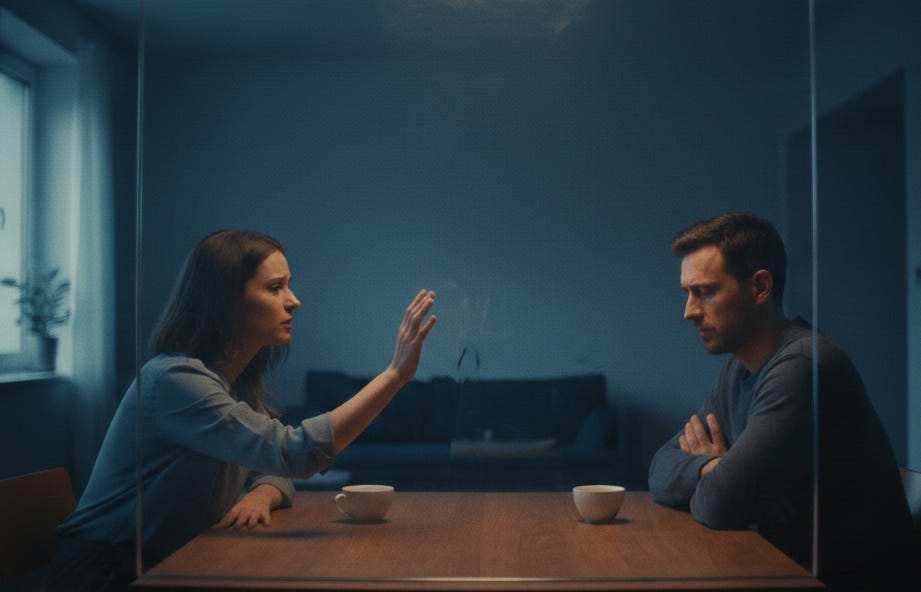
“I’m sorry.”
You wait for the shift. For their face to soften. For the tension to dissolve.
Instead, they look at you like you just made it worse.
“You don’t even know what you’re apologizing for.”
Your chest tightens. “I just said I’m sorry. I’m trying to make this right.”
“You’re trying to make it stop.”
And they’re right.
You are.
You Try Again
Three days later. Different issue, same dynamic.
They tell you something you did hurt them. You feel that familiar tightness in your chest, the scrambling in your mind for the right thing to say.
“I’m really sorry. I didn’t mean to hurt you.”
They go quiet. Not the softening kind of quiet. The kind that tells you nothing landed.
“What?” you ask. “I apologized. I acknowledged it. What else do you want?”
“I want you to understand what you’re apologizing for.”
You feel frustration rising. “I do understand. That’s why I said I’m sorry.”
But you don’t. Not really. You know you hurt them. You feel terrible about it. You want this feeling to stop. So you offered the words you have been taught will make it stop.
And somehow, it made it worse.
You Try Saying It Better
A week later.
This time you prepare. When they tell you something you did made them feel dismissed, you take a breath. You use the language you learned in therapy.
“I hear you. I’m sorry that I made you feel that way. That wasn’t my intention.”
Their jaw tightens. “Your intention doesn’t change the impact.”
“I know. I’m not trying to defend myself. I’m just saying I’m sorry.”
“Are you?”
The question catches you off guard. “Yes. I just said that.”
“You said the words. But you’re not actually here with me.”
You want to scream. You apologized. You used feeling words. You acknowledged impact over intention. You did everything right. And it still was not enough.
What are they asking for that you are not giving?
The Pattern You Cannot See
You have been in this loop for months, maybe years.
They tell you that you hurt them. You apologize. They stay hurt. You apologize again, with more emphasis, better language, clearer acknowledgment. They remain unsatisfied. You feel trapped, confused, increasingly resentful.
You start to think: Nothing I do will ever be enough for them. They are holding onto this. They want me to grovel. They are being unfair.
Or you think: I am terrible at this. I keep hurting them. I am a bad partner. Maybe I am just incapable of doing this right.
Both stories miss what is actually happening.
Because the issue is not the words you are using. The issue is what you are trying to accomplish with them.
What Is Actually Happening When You Say “I’m Sorry”
When someone you love tells you they are hurting, something uncomfortable rises in your body immediately.
Your chest gets tight. Your thoughts start scrambling for explanations. You feel the pressure of being the source of their pain, and your nervous system does what it is designed to do: it looks for the fastest way to reduce threat.
So you say the words you have been taught will fix it.
“I’m sorry.”
And you mean it. Or at least, you think you do. But what you actually mean is: I am uncomfortable with your pain. I need this feeling to stop. I am apologizing so we can move past this moment and return to equilibrium.
The apology is not about entering their hurt. It is about escaping your own discomfort.
Your partner’s nervous system registers this immediately. They hear the words “I’m sorry” but feel you pulling away. They sense you are not trying to understand their pain. You are trying to make it disappear so you can feel better.
An apology without presence is not repair. It is withdrawal disguised as accountability.
And no matter how many times you say the words, if you are saying them to escape instead of to repair, they will keep landing wrong.
The Moment I Realized I Was Apologizing to Escape
I have been the person who says “I’m sorry” and genuinely cannot understand why it makes things worse.
My partner would tell me something I did hurt her. And immediately, before she even finished speaking, I would feel my body brace. The tightness in my chest. The heat rising in my face. The overwhelming urge to make this feeling stop.
So I would apologize. Quickly. Sincerely. And then wait for her to accept it so we could move on.
But she would not move on. She would keep trying to explain. And I would feel my frustration building because I already said the words. I already took responsibility. What more could she possibly need from me?
It took me years to understand what was happening.
I was not apologizing because I understood her pain. I was apologizing because I could not tolerate the feeling of being the cause of it. My nervous system was in threat, and “I’m sorry” was the fastest way to discharge that threat and return to safety.
But her nervous system was asking for something else entirely. She was not asking me to end the discomfort. She was asking me to enter it with her. To stay present long enough to actually feel the weight of what happened instead of rushing to resolve it.
The apology I was offering said: I acknowledge this happened. Let’s move past it.
The apology she needed said: I see you. I feel the impact. I am not leaving this moment until you know I understand.
Those are not the same thing.
What Repair Actually Requires
When someone you love says “you hurt me,” they are not asking for the word “sorry.”
They are asking for evidence that their pain matters to you more than your discomfort.
They need to know that you can tolerate the feeling of being the one who caused harm without immediately trying to fix it, explain it, or make it disappear.
Because being told you hurt someone feels terrible. It triggers shame. It makes you want to defend yourself, prove you are not a bad person, restore your image in their eyes as quickly as possible.
But real repair does not happen when you are protecting yourself from that feeling. Real repair happens when you let that feeling exist long enough to actually understand what they experienced.
A real apology does not end the conversation. It opens it.
“I’m sorry. I really want to understand why you are hurting. I am here.”
And then you stay quiet. You do not defend. You do not explain. You do not offer reasons why it was not as bad as they think or remind them of all the times you did not hurt them.
You let their pain have space. You let the silence be uncomfortable.
You let yourself feel the weight of what it means to be the person who caused this, and you do not try to discharge that feeling by making them forgive you faster.
This is unbearable for most people. Because staying present to someone else’s hurt without trying to fix it or minimize it or redirect it feels like drowning. Your nervous system will scream at you to do something, say something, make this stop.
But repair lives in your ability to not make it stop.
When “I’m Sorry” Becomes a Weapon
There is a version of this that is even worse than the quick apology.
It is the apology that comes with resentment attached.
“Fine. I’m sorry. Is that what you want to hear?”
Or the apology that turns into a defense halfway through.
“I’m sorry, but you have to understand, I was exhausted and you were being really intense.”
Or the apology that weaponizes your past apologies.
“I have apologized to you a hundred times. When is it ever going to be enough?”
These are not apologies. These are attacks disguised as accountability.
They say: I will perform the motions of remorse, but I will punish you for making me feel this way.
And the person on the receiving end learns something devastating: my pain is a burden. Asking to be seen is asking too much. I should stop bringing my hurt here because it only creates more hurt.
This is how people stop reaching. Not because they have healed. Because they have learned their partner cannot hold them without making it about their own discomfort.
The Apology That Changes Everything
I remember the first time I apologized and stayed.
My partner told me something I did made her feel invisible. And instead of immediately saying “I’m sorry” and waiting for her to move on, I forced myself to sit in the discomfort.
I said, “I really want to understand why you are hurting. I am here.”
And she told me. And it was painful to hear. Every sentence felt like confirmation that I was failing her. My body wanted to interrupt, to explain, to defend. But I stayed.
And when she finished, I did not say “I’m sorry” right away. I sat with what she had just given me. I let it land. I let myself feel how alone she must have felt.
And then I said, “I see it now. I see how my distance made you feel like you did not matter. And I am so sorry.”
The difference was not the words. The difference was that I had actually entered her experience instead of trying to exit my own discomfort.
She cried. Not because I said the perfect thing. Because she felt me there with her for the first time.
That is what an apology can do when it is not an escape.
What to Do When You Realize You Have Been Apologizing to Escape
If you are reading this and recognizing yourself in the person who says “I’m sorry” to end the conversation, you can learn to do something different.
Your body is trying to protect you from the unbearable feeling of being the one who caused harm.
But you can learn to tolerate that feeling long enough to let repair actually happen.
The next time someone tells you that you hurt them, notice what happens in your body. Notice the tightness in your chest. Notice the scrambling thoughts. Notice the urge to fix it immediately.
And instead of following that urge, pause. Take a breath.
Say: “I am here. I want to understand.” And then be quiet.
Your body will resist. Your heart rate will spike. Your palms might sweat. You will feel the urge to fill the silence with explanations, with context, with anything that makes you feel less exposed. That discomfort is the work. Stay in it.
Let them tell you what it felt like. Do not defend. Do not explain. Do not offer reasons. Just listen.
Your nervous system will hate this. It will tell you that staying silent means you are admitting you are a terrible person. It will tell you that if you do not defend yourself, they will think the worst of you.
But what actually happens when you stay present is the opposite.
When you stop trying to escape their pain and let yourself feel the weight of it, something shifts. They feel it in your body. They see that you are not running. And that presence, that willingness to stay, communicates something no apology ever could:
Your hurt matters more to me than my comfort. That is what repair actually is.
The Question You Have to Answer
The next time someone you love says “you hurt me,” you will have a choice.
You can apologize to escape. You can say the words quickly, hope they work, and try to restore equilibrium as fast as possible.
Or you can apologize to repair. You can stay present. You can tolerate the discomfort of being the one who caused harm without rushing to make yourself feel better.
One protects you from shame. The other builds trust.
One ends the conversation. The other opens it.
One makes your partner feel alone. The other makes them feel seen.
The words “I’m sorry” are the same in both versions.
But the nervous system knows which one you are offering.
And so does the person waiting to see if you will stay.
About Eric:
Eric Bensoussan is a relationship coach and nervous system specialist with 13 years of experience helping couples move beyond surface-level communication into embodied vulnerability. His work focuses on breaking recurring relationship patterns through nervous system regulation rather than traditional talk therapy approaches.
If you recognize this pattern in your relationship and want support learning to navigate these moments of vulnerability, book a complimentary call.